
I recorded this because I had just come out of a meeting with a group of CEOs, and the same question came up more than once. How should I, as a CEO or business owner, really be spending my time?
That question matters because a lot of owners stay busy all day without ever stepping back to measure whether their time is being used well. I want to give you a simple way to look at that honestly and make better decisions from there.
Why This Question Keeps Coming Up for Business Owners
In that meeting, I heard business owners asking some version of the same thing in multiple breakout sessions. They wanted to know how a CEO should spend the day, and that is a fair question because most owners are pulled in too many directions at once.
If you are a solopreneur, you may feel like you have to do everything yourself. Even then, you still have to decide whether your time is best spent doing the work personally or having someone else handle parts of it so you can focus on what produces more value.
That kind of decision-making lines up with the leadership issues I cover in Small Business Leadership, where the real goal is to use your role intentionally instead of reacting all day.’

What I Mean by a CEO Timecard
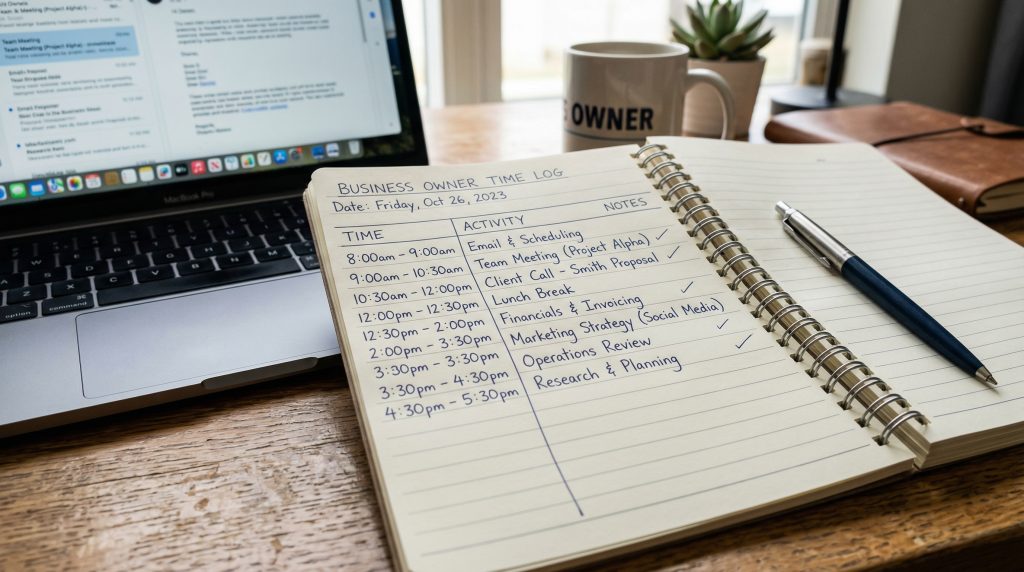
One of the ideas we pioneered is what I call a CEO timecard. The concept is straightforward. You write down how you actually spend your day every day for about a week or two.
The point is not to create a perfect record for its own sake. The point is to find out what you are really spending time on so you can see whether that time is being used wisely.
Quick Answer
Track your activities for one to two weeks, review the pattern, and then decide what you should keep doing, what someone else could do, and what may be wasting your time.
Step Breakdown
- Write down how you spent your workday each day.
- Be specific about the major chunks of time.
- Do this consistently for at least one week, and preferably two.
- Review the record to see where your time is actually going.
- Identify work that should be delegated, outsourced, or stopped.
If you want more structured business training around this kind of thinking, start with the courses available page so you can see the broader set of topics we teach.
What a Timecard Helps Me See
Once I track the day honestly, I can usually see patterns very quickly. A business owner may be spending a couple of hours a day talking to prospective customers, following up on sales, talking to employees, or managing sales reps.
None of those activities are automatically wrong. The issue is whether they are the best use of the owner’s time, or whether some of them should be handled by somebody else.
Examples
For example, I may find that too much of the day is being spent on follow-up work that could be standardized or assigned. I may also find that conversations with prospects are exactly where I should be spending more time because that is where the revenue starts.
That same practical mindset shows up in the 10-10-10 Plan, where disciplined review helps you make better decisions instead of drifting through the week.

When to Delegate or Outsource
The reason I like this exercise is that it makes delegation easier to see. If I can make more money for the company by doing what I do best and having someone else do lower-value work, then that is worth serious consideration.
That someone else may be an outside contractor, or it may be an employee, depending on the size and structure of the business. The timecard does not make the decision for me, but it gives me the information I need to make the decision intelligently.
Short Clarification
Being busy is not the same as being effective. A CEO timecard helps separate necessary work from work that simply landed on your desk because nobody stopped to question it.
If you are also working on building a stronger management bench, you may find the Techniques for Selecting a Supervisor article helpful, along with the broader material on the blog.

Mini FAQ
How long should I track my time?
I recommend about a week or two because that is long enough to reveal patterns. A single day can be unusual, but a week or two gives me a more reliable picture.
What if I am a solopreneur?
That does not remove the need to review your time. It makes the exercise even more important because you need to know what really deserves your direct attention and what could be handled another way.
What am I looking for when I review the timecard?
I am looking for waste, repetition, and tasks that somebody else could reasonably do. I am also looking for the work that truly requires my involvement so I can protect more time for it.
Final Wrap
I have done this exercise several times myself, and I have used it while counseling clients here in Phoenix and in other areas. It is simple, but it gives me a much clearer picture of whether I am using my day the way I should.
If you want to get more out of your time as a CEO or business owner, start by writing it down and reviewing it honestly. This blog post is built directly from the transcript below, and the core lesson is the same: know where your time goes before you decide what should change.
Transcript
0:01
Good morning. This is John Heinrich, from the Solutions Forum and Small Business Success School, and all those other good things. The reason I wanted to do this recording was that, in fact, I was in an all-inclusive meeting with a bunch of other business CEOs yesterday. One of the questions that came up a couple of times in the three or four breakout sessions was, how do I, as a CEO, spend my time or as a business owner?
0:30
Of course, if you’re a solopreneur, as many of them were, you’ve gotta do all the things that you think are necessary, but you can hire outside contractors to do them if you think you can make more money. For the company doing what you’re doing and hiring someone else to do it, and that someone else might well be an employee, depending on how many people you’ve got working for you.
0:54
One of the things that we pioneered, I think as far as I know, is the idea of a CEO timecard, where you can actually write down how you spent your day every day for about a week or two. Find out what you’re spending it on. For example, you might be talking to prospective customers for a couple of hours a day.
1:18
You might be following up on sales, or you might be talking to employees. You might be talking to sales reps, if you have sales reps, whatever you’re doing. So the idea is to figure out how you’re spending your time to make sure you’re not wasting it, or you’re not doing things that other people could do. We’re kind of big on this.
1:41
I did it, I’ve done it several times. Counseling clients here in Phoenix and other areas. And if it’s a big topic, let us know, and we’ll do a course on it, a formal course. So once again, thanks for your attention, and we’ll look forward to chatting with you. Bye-bye.